
Progress and reporting
You should never have to wait until the end of term to understand how your child is doing.
Bridgecombe makes progress visible while learning is happening.
Immediate feedback, daily parent updates, weekly summaries, planned diagnostics and detailed reports show what your child understands, where they are improving, why difficulties are occurring and what should happen next.
Daily insight · Weekly clarity · Planned diagnostics · Adjusted next steps
More than marks and percentages
A score tells you what happened. Strong evidence tells you why and what should change.
Bridgecombe identifies what your child understands securely, what is improving, why errors or difficulties are occurring and whether the learner is ready to move forward.
This evidence flows through one connected rhythm:
Learning activity → immediate feedback → daily guidance → parent pulse → weekly summary → planned diagnostic → detailed report → adjusted pathway
We do not collect information simply to produce another report.
We use it to improve the teaching, strengthen the weekly plan and make better decisions about what your child should do next.
A clear rhythm of feedback and review
Progress is monitored at the moments when action can still make a difference.
During learning
Bridgecombe’s AI subject coaches respond while the learner is working. They can identify misunderstanding, change the explanation, adjust the language, provide further practice and check whether understanding has improved.
During daily guidance
In the focused 30-minute guidance session on each planned learning day, the Bridgecombe educator brings together learning evidence, expert judgement and family priorities, clarifying difficulties, recognising progress and agreeing the immediate way forward.
Through the daily parent pulse
Families receive a concise update on each planned learning day, showing what was completed, how successfully the learner engaged, an important difficulty or breakthrough and what happens next.
Through the weekly summary
A weekly written summary shows what has been studied, what is secure, what needs further attention and how the learning plan will change for the following week.
You remain closely connected to your child’s education without having to become the teacher, marker or curriculum manager.
Precision without constant testing
Every assessment has a reason.
Across Bridgecombe’s KS3 subjects, learning is organised into ten focused units, each built around ten clearly defined micro-skills.
This keeps learning manageable, purposeful and able to move at pace without becoming repetitive. It also gives Bridgecombe precise evidence of what is secure, what needs recovery and where the learner is ready for greater challenge.
At GCSE and A Level, learning follows the chosen exam-board curriculum and specification, combining direct instruction, guided practice, diagnostic evaluation, retrieval and past-paper-style questions.
Checks are placed deliberately: at the beginning of learning where baseline evidence is useful, at meaningful points during a unit and before the learner moves into greater challenge. They help determine whether the learner needs recovery, consolidation, extension, examination practice or progression.
Assessment is not an interruption to learning. It is one of the ways we make learning more precise.
Detailed evidence made clear
Progress should be visible, not hidden inside a grade.
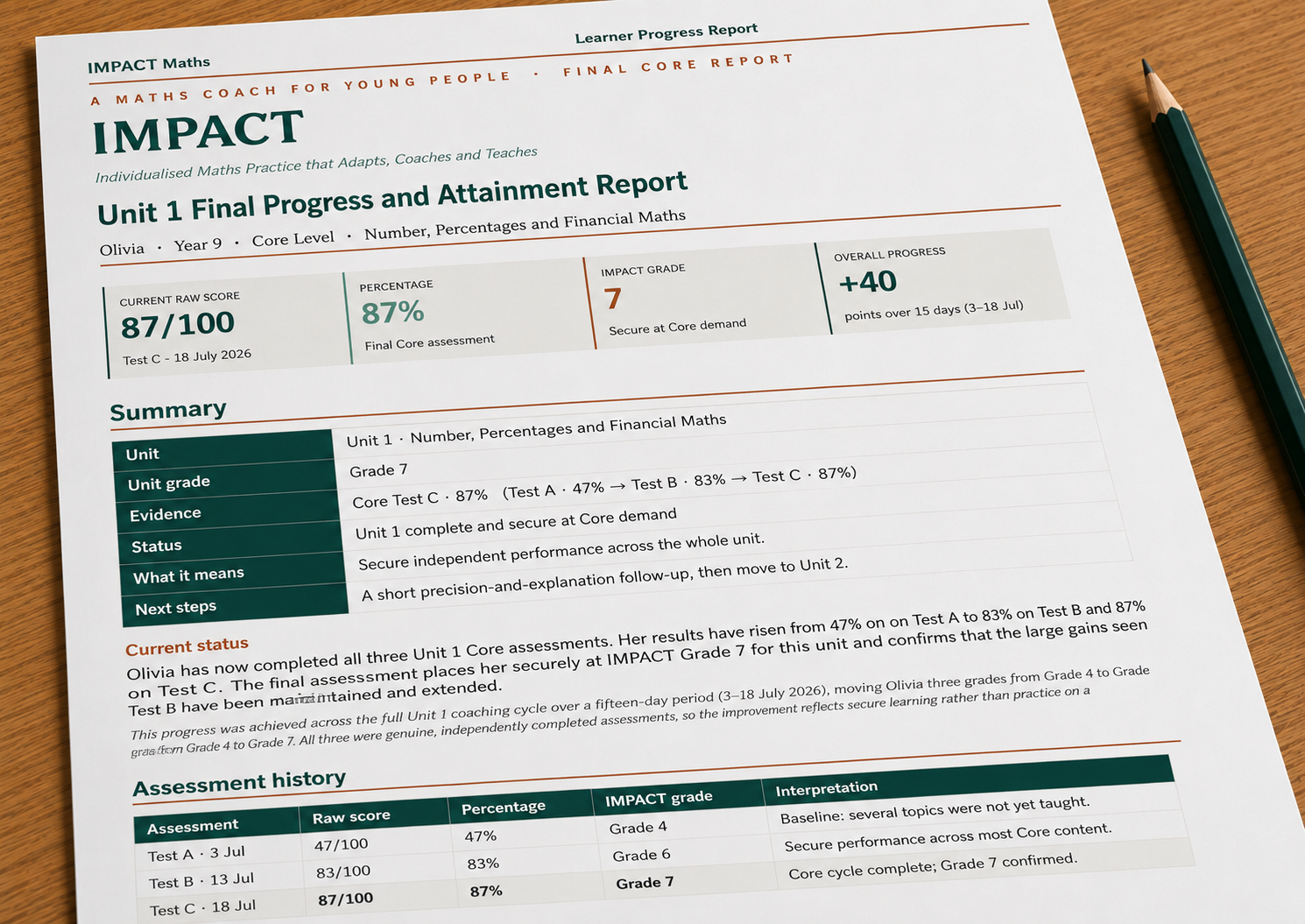
In one recent IMPACT Maths unit, a learner progressed from 47% to 83%.
The report did not stop at the improved score. It showed progress across individual micro-skills, which knowledge had become securely understood, why particular errors were occurring and the exact follow-up required.
The evidence showed that the learner did not need to repeat the entire unit. A short, precision-focused follow-up was recommended before progression.
The purpose of reporting is not simply to describe performance. It is to make the next decision better.
Personalisation made visible
What Bridgecombe learns about your child changes what Bridgecombe does next.
Evidence feeds directly into the next explanation, the daily guidance conversation, the weekly learning plan and the wider Personal Academic Pathway. It may lead to recovery of an insecure foundation, consolidation, extension, progression or a change of pace.
A learner who needs recovery is not pushed forward with an unresolved gap. A learner who is ready for more is not held back by unnecessary repetition.